Total Pageviews

Pages

Tuesday, January 11, 2011

A Taste of Italy: Tuscany (2)


Sangiovese - Prugnolo Gentile
 In part 1 one of this feature under the above title, I mentioned that apart from its Chianti's and Brunello's di Montalcino DOCG red wines, Tuscany is also renowned for the production of another Sangiovese clone wine. This wine is the VINO NOBILE DI MONTEPULCIANO which is produced from a "Sangiovese Prugnolo Gentile" dominated blend which carries the DOCG classification.

The review team have selected two samples of this wine produced by the same winemaker but from different vintages. The wines selected are the CARPINETO VINO NOBILE DI MONTEPULCIANO 2000 RISERVA DOCG and the 2003 DOCG RISERVA vintages.

Riserva Vino Nobile di Montepulciano produced in good vintages can be cellar aged well up to 15 years, and so both these wines would have opened up, evolved and developed splendidly after 10 years for the 2000 vintage and 7 years for the 2003. Both vintages did not disappoint the review team, who found these wines reminiscent of an exceptional Chianti Classico's perfume, and a splendid Brunello Di Montalcino's richness and robustness combined together, thus making this wine style extremely enjoyable and elegant.

Carpineto Vino Nobile Di Montepulciano 2000 - 2003
Grape Varieties: The Carpineto Vino Nobile di Montepulciano Riservas are produced from a blend of 70% Sangiovese (Prugnolo Gentile), and 30% of Canaiolo and Merlot grape varieties.

Vinification: After pressing maceration of the skins with the must takes place over 10 to 15 days, with frequent gentle pumping over, and under controlled temperatures of 25 to 30 deg.C.

Maturing for 2 years - takes place in large 5,500 liters Slavonian, oval oak barrels with a small part in French oak barrels, in natural caves excavated on the Carpineto estate, which maintain a naturally constant temperature of 13deg.C year round.

Aging: After bottling this Riserva is kept in the winemaker's cellars under temperature controlled conditions for a further 2 years before final release to the consumer. This is a full 12 months more than that required by the DOCG appelation rules for a riserva wine.

The Answer is wine - What was the question?
Tasting Results: This procedure resulted in a medium-bodied wine, having a brilliant ruby red colour with a garnet tendency and orange notes due to the wines' age after release. On the nose, the wine has aromas of dark cherry and rich ripe plums, extraordinarily elegant with floral hints of violet and wood. On the palate the wines are big and creamy and evolve with a rich taste of ripe strawberries, prune and cherry flavours with a hint of tea leaves due to the wine's firm tannins. Forceful tannins and bright acidity makes for a lingering and well rounded finish, and which also make these wines age worthy.

Alcoholic content: 13% by volume.

Enoteca price range: Eur25

RATING: RS91


Bistecca ala Fiorentina.

Ravioli with Red Sauce.
Beef & Walnuts Stuffed Pork Fillet
Beef Stuffed Cannelloni.


Food pairing: Rich Italian and Mediterranean cuisine; roast red meats, lamb; rare beef steaks; Bistecca ala Fiorentina; aged cheeses; game especially wild boar; pasta and pizza.


Choice of Italian and Mediterranean Cuisine.

Monday, January 3, 2011

A Taste of Malta: The Blends - Part 1.

Over the last few weeks, I have been very busy sorting out the various wines produced by the main winemakers in Malta. There are at present some classy and very good wines on the market, produced under the Malta Wine Classification Laws of Malta, which came into effect in 2007, but it was decided to review and rate only the top, premium wines released by each winemaker and then only the ones that have been rated highly.
It was further decided that rather than reviewing the wines from each producer individually, it was much better to review the wines in a comparative method in accordance with their grape variety, composition or blend in comparison with all producers.

The Malta Blends - Classic Wine Blends.
For the first review under the title "A Taste of Malta", I am going to cover The Malta Blends, in two parts.

A "Blend" is a wine composed and produced from different grape varieties, blended in accordance with the winemaker's own formula and recipe' to produce in most cases, superior, individual wines that are in some cases the winemaker's talisman or icon wine. Blends are designed and formulated to add more complexity to the flavour and texture of a wine like nothing else in the winemaker's stable or on the market.

In Tuscany,  the so-called "Super Tuscans" started to be produced in the 1970's when Italian winemakers decided to raise the standard and quality of their wines, and created a new style and very exciting red wine outside the DOCG laws. And so the famous Sassicaia and later the Tignanello were born. These wines were made from grape varieties of the winemakers' own choosing, who blended a selection of two, three or more of the following grape varietals:
Cabernet Sauvignon; Merlot; Cabernet Franc; Sangiovese; Syrah; Petit Verdot.
Notwithstanding this, a Super-Tuscan can be prettry much anything. It can take the form of a mono-varietal, or any blend of varietals from the above grape varieties. These wines are classified as IGT wines as they are not bound by any rigid production traditions or rules.


In France, the Bordeaux Blends were already in existence for many years and are still very popular and well sought after to this day. The only grapes that are allowed for use in a French wine blend to be labeled Bordeaux are:
Cabernet Sauvignon; Merlot; Cabernet Franc; Malbec; Petit Verdot; Carmenere. 
Wine vintners generally use or choose two to three different grape varieties from the approved "Bordeaux" list, but rarely if ever, use all six grape varieties in one resulting wine. These wines are of course controlled by the exacting French wine appellation laws and boast the Apellation d'Origine Controlee AOC appellation.

Many winemakers in all the major wine producing countries, both in the "Old World" as well as in the "New World" wine producing countries and regions, have also opted to produce their own individual versions of the "Super Tuscans" or "Bordeaux Blends", or to put it mildly their own individual blends, by formulating wine blends from a selection of both the Tuscan grape varieties, as well as the Bordeaux varieties, as well as from indegenious grape varieties grown in their specific country and region, and marketed under different brand names.
Blended wines have been around for hundred of years, well before these two styles, and if one has to take an example Chateauneuf-du-Pape in some form or other has been around since the time of Pope John XXII, circa 1316 - 1334.

MALTA is no exception to this trend, and since the introduction of the wine classification laws in 2007, wine estates have not only grown in the cultivation of the international grape varieties, but they were constrained to produce lower yields with better cultivation of the vines, efficient irrigation and drainage systems, and the utilization of the best clones planted in sun facing regions on the Island. This resulted in the production and release of some fine wines, year-in year-out, which do the winemakers proud.

For the purpose of this feature, I have selected some of the very best, premium blends from various winemakers in Malta, which have been formulated and judiciously blended by each individual winemaker in accordance with his own preference, and which we are reviewing and rating hereunder.

In part 1 of this topic we shall be reviewing four of these wine blends under the blend headings:
The Malta Blends -Rated & Awarded RS90 points
for excellence of quality.

A. MERLOT/CABERNET SAUVIGNON BLEND.

A classic varietal combination in the world of wine, Cabernet Sauvignon and Merlot are two of the most popular red wine varieties throughout the world. When blended together, they form a classic combination that is identified by breeding and distinction. Ideal blends of Cabernet Sauvignon and Merlot is about 70% of the former and some 30% of the latter. Blend composition may vary from one producer to another as there are no hard or set rules.
This blend produces a full-bodied red wine, having a deep black colour, with a bouquet of chocolate, plums and violets. On the palate this combination produce flavours of black currant and dark chocolate, pepper and plums. The wine has strong tannins which are well balanced with natural acidity and alcohol. The finish in these wines is lingering and full of fruit.

Two wines which have the above characteristics from the Malta blends are the:

1. LAURENTI - MERLOT/ CABERNET SAUVIGNON 2007 MALTA DOK.
    Producer: Camilleri Wines Ltd - Malta.
    Alcohol content: 13% - FULL-BODIED.
    After fermentation on the skins, and malolactic fermentation is achieved the wine is blended and  transferred to mature for fourteen months in new French oak barriques thus aquiring a typical vanilla flavour. The wine is then bottled and left to age in the bottle for various months prior to release.
This wine can be aged for a number of years to evolve and develop further.
Wine boutique or wine shop price: Eur 10.

RATING: RS90

2. MERIDIANA MELQART 2006 & MERIDIANA MELQART 2007 MALTA DOK
    MERLOT/CABERNET SAUVIGNON.
    Winemaker: Meridiana Wine Estate - Ta' Qali, Malta.
     Alcohol Content: 12% - Medium-bodied.
This wine is produced from a careful blending of these two grape varieties, and after fermentation under temperature controlled conditions, and maturation in French oak barriques for several months, the wine is bottled and left to age in the estate's cellars for more months to develop further. The wine is unfiltered and unrefined to retain its full fruit flavour.
Consumer price - wineshop/boutique/enoteca: Eur14.

RATING:  RS90.

B. CABERNET SAUVIGNON/ SYRAH BLEND.

This blend produces wines that are dark, ruby red in colour, with impressive aromas of licorice, pepper and black currant and berries. Full-bodied with strong tannins, good acidity, reserved and balanced. The finish of these wines is long and lingering as befits these two strong grape varieties.

The two wines that we have selected to represent this category in the Malta blends category are the:

1. PIANOFORTE CABERNET/ SYRAH 2007 MALTA DOK SUPERIOR.
   Winemaker: Camilleri Wines - Malta.
    Alcohol content: 12.5% - Full-bodied.
The resulting wine has a beautiful balance between fruit, oak, tannins and completes in an elegant finish.
Matured in oak barriques for twelve months and aged in the bottle until released in 2010.

Available in selected restaurants only - Price range: Eur15 to Eur20 depending on restaurant.

RATING: RS90.

2. GRAND VIN DE HAUTEVILLE 2009 -SHIRAZ/CABERNET MALTA DOK SUPERIOR.
     Winemaker: Emm. Delicata & Sons Ltd - Malta.
     Alcohol content: 13.5% - Full-bodied.
The rich luscious fruit of the Shiraz combines well with the supple tannins and elegant structure of the Cabernet Sauvignon cultivated in small, family boutique estates, to produce a fine wine with good fruit on both the nose and on the palate.

Wineshop/boutique/enoteca price range: Eur9.

RATING: RS90.

Given their youth, it is recommended that these wines are opened at least one hour prior to drinking and preferably decanted for a more elegant and mellow taste in the mouth.

The four wines have been taste-tested in comparison with each other:  on opening; after three hours of opening; after decanting; and with food. The differences in taste vary but the quality and thus the final rating match up nicely to warrant an RS90 consumer rating.

Food pairings with these four Classic Malta Blends are:     Red meats-roast beef; roast lamb; grilled prime beef steaks; bistecca alla Fiorentina; pasta with rabbit sauce or rich red sauce; rabbit stew; fried rabbit in olive oil and garlic; fresh tuna; fresh salmon; strong mature cheeses; game and poultry; turkey drumsticks or whole thigh; roast lamb shanks.
Part two of "A Taste of Malta:The Blends" will be featured shortly.

Thursday, December 30, 2010

Best wishes for the coming New Year 2011.

Reno Spiteri & granddaughter Julia wish all of you a
Very Successful & Happy New Year 2011.
I have not posted any features these last couple of weeks due to the Festive Season's commitments.
I have a few features in preparation on various wine topics and shall continue with the popular features "A Taste of:.." in January. I have reviewed selected premium wines from Campania, Piedmonte, Malta, more from Tuscany and Sicily, and some others are also lined up from other countries and regions.

I shall be changing the large photo display of the Vina' Tondonia White Gran Riserva 1964 at the beginning of the year, so if you are a wine producer, anywhere in the world, and wishes me to display your topmost, premium wine brand for six months at the head of this website, contact me on lineking@onvol.net for further details.

In the meantime, I wish everyone that follows this website, wine producers, wine enthusiasts and afficionados, sponsors and friends a VERY SUCCESSFUL AND HAPPY NEW YEAR 2011.
Happy New Year to all. Thanks for your support.

Next feature due first week of January. Stay tuned.

Best Regards & Heartful Best Wishes,

Reno Spiteri.

Sunday, December 19, 2010

A Taste of Italy: TUSCANY (1).

Sangiovese grape variety cluster.
TUSCANY is the quintessential Italian wine region and is the home of three of Italy's most important wines: Chianti; Brunello di Monatlcino; and Vino Nobile di Montepulciano. It is also the home of the "Super Tuscans", a range of IGT non-traditional wines that are superlative in quality.

The Sangiovese grape variety is the most important red grape in this region, and apart from its use in the production of the above three, major, traditional wines, it is considered to be one of the greatest red grapes in Italy.

Since the 1970's and 80' when the major winemakers of Italy decided to produce wines of a much higher quality than in the past, and with the advent of the new Italian wine classification laws coming into play, not only were the traditional wines improved to world class calibre but this era gave birth to a high quality wine which was produced outside the norms and rules in an untraditional manner. These are the so called "Super Tuscans", which apart from being superlative wines, are in most cases quite expensive.

With so much excellent red wines being produced in Tuscany, with the exception of the region's famous and unique dessert wine, known as Vin Santo, white wine has been mostly an aftertought for both wine producers and wine drinkers. Therefore, although some very good and exciting white wine is being produced in small quantities from mainly Chardonnay, Sauvignon Blanc and from Tuscany's traditional Vernacchia di San Giminiano grape varieties, we shall at this stage deal with examples of three of the top Tuscan red wines and a sample of the sweet Vin Santo.

Chianti Selections: Riserva, Classico and Chianti
To understand these wines we have to emphasise the fact that the Sangiovese grape varietal comes in different clones, and that the main ones differ enormously in flavour. The major Sangiovese clones are the "Sangioveto", which is one of the clones found in the production of the very best Chiantis. Chianti wine comes under names of Chianti Riserva, Chianti Classico and just Chianti, all boasting the coveted DOCG classification, although most vary in taste and quality depending on the blend, and the calibre of the Sangiovese grape vintage which must provide 85% or more of the wine blend.
For the production of Brunello di Montalcino we have the "Brunello" clone; and the "Prugnolo" clone is used in the production of Vino Nobile di Montepulciano.

Trebiano and Malvasia vines have been planted over a period of many years for the production of the white and sweet dessert wine Vin Santo.

The four wines that we have under review in this first feature about Tuscany, are produced by:
CANTINE LEONARDO DA VINCI of Vinci, Florence, Tuscany:

1. DA VINCI CHIANTI RISERVA 2006 DOCG.

Da Vinci Chianti Riserva 2006.
This wine is an extremely supple wine, which in my opinion is less tannic than a Cabernet Sauvignon and more elegant than a Syrah or a Merlot wine. It contains excellent balance and good acidity that cleans the palate and makes one want to eat and enjoy food more. Hence, Tuscany's traditional seven course lunches and dinners, with selections of antipasti, primo piatti for various pasta and ravioli with ricotta and different sauces, secondi of bistecca ala fiorentina, grilled chicken, roast lamb; accompanied by selections of fresh vegetables; various dolci fatti in casa (desserts), fresh fruit, cheeses and coffee.

The Da Vinci Chianti Riserva is only produced if vintages are good and the Da Vinci Riserva 2006 is produced from pure "Sangioveto" Sangiovese grapes. This vintage has won the International Wine Challenge 2009 Bronze medal and the AWC Vienna 2009 Silver Medal. The 2004 Riserva which we have also taste- tested was also produced from 85% pure Sangiovese grapes, 10% Merlot and a 5%  blend of Syrah, Canaiolo and Colorino grapes.

The 2006 Da Vinci Chianti Riserva 2006 DOCG is ruby red in colour, full-bodied and with a distincly fruity bouquet of ripe cherries with hints of vanilla and cinamon. On the palate the wine is spicy yet mellow, with hints of chocolate, cherry and prunes and a little salt. The finish is lingering with balanced tannins and good acidity.

Alcohol content: 13% by volume.
Serving temperature: 18 deg. C.
Price range: Eur16.

RATING: RS92.

2. DA VINCI BRUNELLO DI MONTALCINO 2005 DOCG.

A taste of Brunello di Montalcino.
The dark one, or as it is more commonly known BRUNELLO, is Tuscany's most exalted wine. It is considered to be Tuscany's rarest and most expensive range of wines. It is made in Montalcino, hence the official name and classification of Brunello di Montalcino. This region is some two hours drive from the Chianti Classico region.

Brunello di Montalcino is based on the Sangiovese - Brunello clone- alone, and unlike Chianti and Vino Nobile di Montepulciano, other grape varieties are not blended in with the Brunello Siangiovese grape varietal to layer in more flavour in weak vintage years. In good years, the brunello clone, yields a lavish full-bodied wine, with more structure, texture and complexity than Chianti, having splendid aromas and flavour.

The Da Vinci Brunello di Montalcino 2005 DOCG, is clear and purple red, with orange shades that are typical of all excellent red wines. It is produced from 100% pure "Brunello" Sangiovese grapes, handpicked and sourced from the small hillside in the commune of Montalcino. The wine takes a long, careful time to be produced with fermentation and maceration taking about 15 to 20 days with frequent pumping over. Fermentation then takes place in 100% stainless steels tanks under controlled conditions to ensure excellent colour and good tannins. Once fermented the wine is then aged in oak barrels for two years. After this period the wine spends three years aging in the bottle prior to its release.

The wine has a rich bouquet of chocolate, blackberry and cherrys,. On the palate it is full-bodied and well balanced with strong tannins and good acidity, with tastes of cinamom, spice and black pepper. It has a very elegant, long and persistent finish with an excellent aftertaste of fruit.

Alcohol content: 13% by volume.
Serving Temperature: 18 Deg. C.
Price range: Eur36.

RATING: RS93.

3. STO. IPPOLITO - TOSCANA 2006 IGT. (Super-Tuscan).

Da Vinci Super-Tuscan Sto. Ippolito 2006.
Super-Tuscan wines are classified as IGT wines, but nevertheless they are some of the very best and most expensive wines on the market. Choosing a Super-Tuscan is a matter of taste as the blends vary in accordance with the winemakers' own formula, and may and may not contain Sangiovese in the final blend. What one can say at this stage is, that the Super-Tuscan concept is no longer the sole preserve of the world famous Sassicaia or Tignanello, as other producers in Tuscany are producing and introducing various excellent wines which fall under this category. Super-Tuscans are made in an international style, generally dense and powerful, packed with tannins and good acidity and imparting that vanilla flavour which is eminated to the wine by new oak barriques in which the wine is matured.

The SANTO IPPOLITO-TOSCANA 2006 IGT Super-Tuscan is produced from a blend of 50% Syrah and 50% Merlot grapes, grown and harvested on the small hilly area of Sto. Ippolito near Florence.
Maceration takes place on the skins for some 20 days with frequent, gentle pumping over to maintain good colour, supple tannis and the rich fruit aromas and flavours that are characteristic to both grape varieties.
The wine is then matured for twelve months in 2.25 hectolitre barrique, after which it is racked into bottles without fining or filtration. The wine is aged for a further six months before release.

Purple-red in colour, with good depth and legs on the glass indicating a strong structure. On the nose one immediately senses  red fruit perfumes, with spicy oaky vanilla and black pepper, and toasted oak. On the palate it is savoury and soft at the same time with a strong, ripe and  fruity taste. Tannis, acidity and alcohol are perfectly balanced, giving a lenghty and elegant finish.

Alcohol content: 13%
Serving Temperature : 18 Deg.C
Price range: Eur20.

RATING: RS91.

FOOD PAIRING: The above three traditional wines of Tuscany pair well with roast lamb; roast beef and grilled prime steaks; bistecca fiorentina; game; mature Pecorino and Parmigiano Reggiano cheeses; dishes containing truffle; pasta with red and meat sauces. Strong and flavoured vegetable dishes. Typical and traditional Tuscany cuisine.

4. DA VINCI VINSANTO 2004 DOC.

The best known sweet wine in Italy is known as Vin Santo, or holy wine. It is so named as it has been drunk by catholic priests for centuries during the celebration of Holy Mass. Vin Santo in Tuscanny is the customary finale' to every decent meal in this region, and is served after dessert with an espresso coffee.

Da Vinci VinSanto Dessert wine.
The Da Vinci VinSanto - Bianco Dell' Empolese DOC 2004,  is produced from a blend of the best clusters of Trebbiano and Malvasia grapes which after carefull handpicking are dried for several days or weeks in the vinsantale to remove all water from the grapes to retain only the nectar prior to pressing, maturing and aging. The result is a superb, rich, amber coloured dessert wine.

This sweet, white, dessert wine is amber in colour, having an intense fragrance of honey and hazelnuts, and with rich, creamy and delicate flavours on the palate as diverse as a selection of honey-roasted nuts and sweet chile raisins. The taste is well rounded and balanced.

Alcohol content: 16.5% by volume.
Price range: Eur28
Food pairing: Desserts and after dinner coffee, espressos.

RATING: RS90.


A taste of Tuscan wines for the enthusiast and afficionado.


Saturday, December 11, 2010

A Taste of Sicily (1).

Nero D'Avola Ripe Grape Bunch.
Sicily is the land where the Medeterranean Triumvirate of Wine, Olive Oil and Bread, is the most apparent. The island's hilly terrain, poor soil and persistent sunlight are tailor made for the production of all three Italian necessities.
For many years, Sicily like many other regions in the south of Italy, suffered from the same mentality that quantity mattered more than quality. Consequently in much of the twentieth century, yields in Sicilian vineyards were pushed to the limit and wine making was haphazard. Thus Sicily and several Southern Italian regions on the mainland, became infamous for the production of extremely cheap vino di tavola, (table wine) of abysmally low quality.

This massive decline in the reputation of Sicilian wines caused several serious producers to launch a mini-revolution to change the status quo in the 1970's and 80's towards the production of better quality wines.

Today, some fascinating wines are coming out of Sicily than was the case even some ten years ago, and although some of these wines are still not yet widely known, some of them rank with the best wines produced in the whole of Italy.

The quality revolution targeted among other grape varietals, the Nero D'Avola  (Calabrese') grape variety, which is an indegenious grape of Sicily. This grape was and still is the most widely planted varietal all over Sicily and consequently was prostituted and abused all over the island in the production of cheap wines by anyone who could make wine, being farmers, vineyard owners and even some commercial winemakers.

In its present cultivation, Nero D'Avola can produce some excellent wine of the highest quality having an intensive black colour, with real depth, fruitiness and appeal. This only came about by the fact that Sicilian winemakers of note, have in their employ the very best wine consultants, agronomists, viniculturists and oneologists. Success does not come easy especially in such a competitive market, and the reconstitution of shattered reputations take a long time and effort to be rebuilt.

A winemaker who has come a long way to produce and bring to the market some of the very best Sicilian wines is FEUDO MONTONI di Fabio Sireci. This winery extends over 73 hectares of prime land in the region of Montoni Vecchi in the province of Cammarata. Wine is derived from an age-old and unadulterated clone of the Nero D'Avola grape variety which has been grown for many years in the Feudo Montoni vineyards.

A premium wine of note from this winemaker which we have been following for some vintages and years is the: FEUDO MONTONI -del Principato di Villanova - NERO D'AVOLA VRUCARA IGT.
Although classified as an IGT wine, this wine ranks well above than some of the best DOCG wines of other varietals. I have taste-tested and reviewed vintages of this wine since the 2005 vintage was introduced to me, with the latest vintage recieved being the 2007 vintage.These wines can be drunk now, but although excellent in their present form, in my opinion these vintages are still very young and require more bottle aging in good cellars to bring out the full structure and complexity of such a full-bodied red wine.

Vrucara 2005 & 2007 Vintages.
The VRUCARA is produced from 100% Nero D'Avola grapes, culled from the very best vineyards of Feudo Montoni, and are handpicked primarily from old vines averaging 40 years.

Vinification: The grapes are destemmed and crushed through soft membrane. The must is then pressed and fermented with natural yeasts and left for a long maceration process on the skins lasting for 25 days under temperature controlled conditions. Malolactic fermentation is then carried out in wooden barrels to soften the acidity.

Oak Aging- is carried out for 8 months in barriques after which, the wine is transferred into larger wooden barrels for another 4 months (tonneaux).

Bottle Aging: The wine is then bottled without any fining or filtering and left to age in the bottle in the winemakers cellars for another 6 months prior to release.

This wine has a dark red, nearly inky black colour, with floral aromas and a bouquet of cherries, vanilla, and berries. On the palate the Vrucara is full-bodied, strong and elegant at the same time, with flavours of red berries, vanilla, ripe plums and chocolate. It has a high level of tannins and decent and good acidity. 

This particular Nero D'Avola wine is rich, complex and well structured, spicey and very well balanced. It has a long, unique and mellow finish which does not leave an aftertatse that would interfere with a sweet dessert after dinner. My recommendation, as with most full-bodied, premium red wines, is to open the bottle about two hours prior to serving and/or to decant it for better complexity and refinement.

Overall, the FEUDO MONTONI NERO D'AVOLA VRUCARA in any of its recent vintages resulted in an excellent premium wine for this grape varietal.

FOOD PAIRING: This wine pairs well with roast shank of lamb; roast red meats; grilled prime steaks; game and mature cheeses.
Alcoholic content by volume is: 13.5%
Price range : Eur30.

RATING: RS92 Points.

Aging potential: 10 to 15 years.

Saturday, December 4, 2010

WHITE WINES- Fish, Seafood and Shellfish.

French Selection - Burgundy whites.
Sommeliers and experts on food and wine have for many years experimented with food and wine pairings and have come to the conclusion that the perfect foods to pair with white wines are fish and seafood. But, alas, when one asks most diners as to what their preferences in white wines are, most would come out with the same stock answer of - Chardonnay, Sauvignon Blanc or in some case a Chenin Blanc. One might ask what about Semillon, Vernacchia di San Giminiano, Greco di Tufo, a Riesling or a Muscadet, Viogner, Vermentino, a crispy Arneis, a Gavi di Gavi, or a Gewurztraminer?


Reno Spiteri's Seafood Platter Arrangement.
 But what makes white wines so perfect a pairing with fish and seafood?
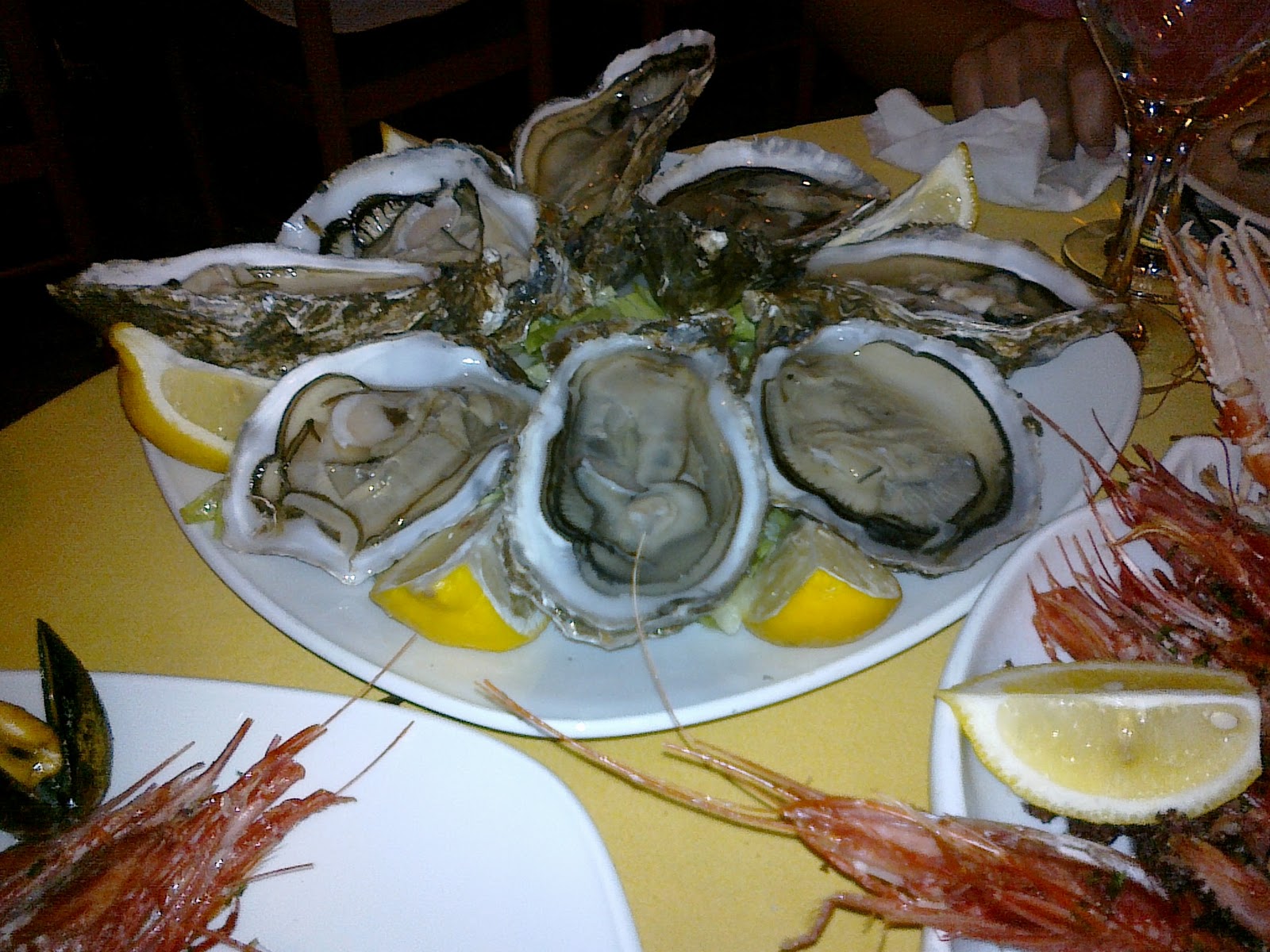
As some shellfish contain iodine, this creates a problem which complicates harmonious pairings with wine. This component has a negative interaction with tannins found in red wine, as it produces a disagreeable metalic flavour on the palate, that is in mouth feel, the taste. In addition to iodine, seafood may also have a very strong flavour, so that the wine should also have a similarly strong structure and also good acidity to lower the intensity of the iodine. This acidity can be found in wines such as a Sauvignon Blanc or a Riesling, a Semillon, Chardonnay, Trebiano, a Viogner and others, which are excellent unoaked and pair well with seafood and shellfish including mussels and oysters. Wine matured in wooden, normally oak barrels or barriques, due to the implemenation of the wood notes (tastes and flavours) in the resultant wine, can be too aggressive and structured for shellfish, and are thus not perfect mates. With reference to Chardonnay, an unoaked wine choice can be suitable if the wine is drunk young to ensure good acidity.

White wine should ideally be drunk at  cooler temparatures, depending on the grape varietal. Temperatures of anything between 8 deg.C and 12 Deg. C are suitable as white wines have a more delicate texture and are lighter bodied than red wines. White wine flavours are generally fresh, citrusy, and having good acidity which gives them a light feel in the mouth, thus creating complimentary flavours and textures which in turn leads to a perfect pairing with fish, shellfish and seafood.

Fish can be classified into three categories: lean, medium-fatty and fatty.


Grilled Scorpion Fish.
 White or lean fish having a high water content are considered to be the most delicate. They have as little or even less than 2% fat per 100grams of fish fillet, which makes them easily digestible in the stomach. Little fat also means that their caloric content is less than 100 calories per 100grams. Lean fish varieties vary from country to country whereas some countries may enjoy lean fish such as cod, haddock and flounder, sole and grouper and red snapper, others might have different species. For these types of fish a delicate and subtle wine is recommended such as an unoaked Chardonnay whose fruity notes compliment perfectly the character of this type of fish. A good Sauvignon Blanc, Pinot Grigio, Trebiano or an excellent Arneis or a Chenin Blanc, all unoaked of course, light or medium bodied, are also good choices, especially for fish eaters who love to squeeze fresh lemon juice on their fish. Creamy sauces should be avoided when drinking unoaked white wine. Other fish types in the lean category include: Bass, Turbot, Monkfish, John Dory ( Pesce di San Pietro), and many others. Wines such as an unoaked Viogner, Vermentino, Greco di Tufo, Semillon, and others are good choices. Seafood and seashells that have a low fat content are: Clams, Crab, Lobster, scallops, shrimps, prawns, oysters and squid. If any of this fish and seafood is served with a cream sauce, as in cases of lobster and crab, then a good oak aged white wine at a temperature of 11deg. C would be your choice.

The second group of fish is the medium-fatty fish category which have some 2% to 6% fat content per 100 grams of fish fillet. Among the most common fish in this category we find: sea bream, scorpion fish, trout, swordfish, marlin, and others. Wines for this type of fish should have more chatacter and could also have a brief aging period in oak barrels, and must be served at the correct temperatures. If the fish cuisine served has a cream sauce, then wine aged in oak is the best choice. Wine choices here are numerous and depend on one's preference of the grape varietal. Light and medium bodied wines are more suitable here.

Italian Whites Selection.
Finally we have the fatty fish category. The fat content in fatty fish, seafood and seashells can vary between 8% and 15% for every 100grams and may also contain a higher caloric content of between 120 and 200 calories per 100 grams. In this category we can include salmon, tuna, sardines, mackarel, farm raised Bream (Awrata), sturgeon, and even octopus. Fat content might vary and depends from which region the fish is caught and even in what season and time of year. The texture of this fish type is fattier and more fibrous and they are best accompanied by wines with the same type of charater and structure. Other fish that are served as popular dishes in the Mediterranean area are: Amberjack (acciola); Dentex (Dentici); Wreckfish (Dott); Pilot Fish (fanfru); Corb (gurbell); Dolphin Fish (lampuka); Pandora (Pagella); Bass (spnotta); and of course there are many others. Maybe I have only mentioned the type that I like or what is mostly found in good fish and seafood restaurants. With this type of fish my wine choices would vary in accordance with how the fish is cooked, grilled, poached, steamed, baked, and the sauce served with it if any. Creamy; or red sauce with tomatos, herbs, and olives; or just plain with lemon juice. Then I pick what I might fancy at the moment, sticking to oaked wine for the creamy servings and the unoaked for the rest. Medium or full bodied wine, chilled to 11 or 12Deg.C, pairs well with this type of fish and seafood.
The list is vast. so I'm giving you here a selection of choices of white wine by body structure:
Light-Bodied White Wines:  Bordeaux white - Semillon, Sauvignon and Muscadelle; Most Italian White wines; Muscadet; Orvieto; Pinot Grigio; Riesling;  Soave; Verdicchio; Vinho Verde.
Medium-Bodied White Wines: Albarino; Bordeaux white wines cru;  Chablis; unoaked Chardonnay; Chenin Blanc; Gewurztraminer; Macon-villages; Pinot Blanc; Pinot Gris;Pouilli-Fuisse'; Pouilly-Fume'; Sancerre; Sauvignon Blanc.
Full-Bodied White Wines: Burgundy white-Chardonnay Grand Cru; Chablis Grand Cru; Oaked Chardonnay; Viogner; Vermentino, Alsatian Pinot Gris; Gavi di Gavi (Cortese'); Greco di Tufo.


Poached Salmon Steak

Mixed Seafood.

White wines selection from Malta.


Saturday, November 20, 2010

Balance: What is it in wine?

A frequently asked question by wine lovers and normal consumers, who are not necessarily wine experts or professionals is how to determine the quality of a wine, regardless of price and without the normal jargon of professional tasters and reviewers. Fair enough. Not everyone has taste buds that determine the different flavours, aromas and taste of particular fruits in a wine. What most consumers are concerned with, is the actual final taste or palate. But as in everything else tastes are subjective and differ from one person to the next. In any case, to determine if your favourite wine, produced from a particular grape variety is good or not compared to another wine made from the same varietal and possibly a different country, here are some basic hints which apply to all wines:

There are four characteristics which one should consider to assess a wine, which when taken together will bring us to the fifth and most important characteristic, viz: BALANCE.

TANNIN: The content of this substance comes from the grape skins, stems, pips and even oak barrels used for aging many wines. It is a natural preservative permitting wine improvement in the bottle. Tannin is not actually a taste but a tactile mouth sensation. The drier your mouth feels after you sip a wine, the more tannin that wine would have.

ACIDITY: All wine has a certain amount of acidity. White wines usually have more acidity than reds. If you are unsure what acidity is, smell and then taste fresh lemon juice or vinegar. If the acidity is too high, the wine is unbalanced, sour and even harsh in the mouth, but on the other hand if the acidity is too low, the wine will taste flat and insipid.

ALCOHOL: Alcohol is the wine product achieved during fermentation of the grape sugar. In Europe fermented grapes juice should reach at least 8.5% alcohol before it legally constitutes wine. The technical European legal maximum alcoholic strenght for wines that have had no alcohol (or sugar) added , is 15%.

BODY: The body or mouth-feel of a wine is an assessment of how light or heavy the wine feels in the mouth. It is related to alcohol levels. Wines that contain more alcohol (e.g. 13% plus by volume) would feel heavier in the mouth. If the body is light think of water; if it is medium think of milk; if it is full think of cream. In some cases full-bodied, premium wines leave a trace , which are sometimes referred to as fingers, inside the glass.

BALANCE: As I said before, Acidity is vital to the balance of a wine's flavour and structure, unless detrimentally affected by residual sugars in the bottle. A balanced wine is one in which none of its components dominates. That is, where tannins, acidity and alcohol, residual sugars and fruit balance each other out to give a smooth and lingering finish to the palate.